An Eternal Monument of Love
Imagine a love so powerful it inspires a building that the whole world comes to see. That’s the story of the Taj Mahal. It’s not just a beautiful palace or a fancy tomb. It's a love letter written in stone, a promise from a heartbroken emperor to his beloved wife that her memory would never fade. For nearly 400 years, this magnificent structure has stood in Agra, India, on the bank of the Yamuna River, capturing the hearts of everyone who lays eyes on it. Its glowing white marble seems to change color with the sky, looking soft and pink at sunrise, brilliant white in the afternoon sun, and golden under the moonlight.
The Taj Mahal is more than just a famous landmark; it’s a masterpiece of art and a symbol of India’s rich history. It was built by the Mughal emperor Shah Jahan, a ruler known for his love of beautiful things, especially architecture. But the Taj Mahal was his greatest project, a final resting place for his favorite wife, Mumtaz Mahal. She was his companion, his advisor, and the love of his life. When she died, he poured all his grief and love into creating a paradise on Earth for her. This is the story of how that dream came to life, a tale of love, loss, and incredible craftsmanship that has touched the world.
The Story of How It Was Built
The story begins with a great love. In the 1600s, India was ruled by the Mughal dynasty. The emperor, Shah Jahan, was married to Arjumand Banu Begum, whom he called Mumtaz Mahal, meaning "the chosen one of the palace." They were deeply in love, and she was his trusted friend and companion. In 1631, after giving birth to their 14th child, Mumtaz Mahal passed away. The emperor was overcome with sadness. It is said that his hair turned grey overnight from grief. Before she died, she made him promise two things: that he would not marry again and that he would build the most beautiful tomb in the world for her.
Shah Jahan kept his promise. That same year, in 1631, work on the Taj Mahal began. He chose a peaceful spot by the Yamuna River in Agra. The project was enormous. It wasn't just one building but a whole complex of gardens, a mosque, and other structures. The emperor brought in the best artists and builders from all over his empire and even from other parts of Asia. The main architect is believed to be Ustad Ahmed Lahori, but it was truly a team effort. Thousands of people—stonemasons, carvers, painters, and laborers—worked day and night. It took over 20,000 workers and more than 20 years to complete this incredible monument, finally finishing around 1653.

A Masterpiece of Art and Design

The Taj Mahal is famous for its perfect symmetry. If you were to draw a line down the middle, both sides would be an exact mirror image of each other. This balance gives it a feeling of peace and harmony. The main building, the tomb itself, is made of pure white marble that was brought all the way from Makrana in Rajasthan, over 400 kilometers away. This isn't just plain marble; it's inlaid with 28 types of precious and semi-precious stones, like jade, lapis lazuli, turquoise, and sapphire. These stones were used to create beautiful patterns of flowers and flowing vines, a technique called 'pietra dura'.
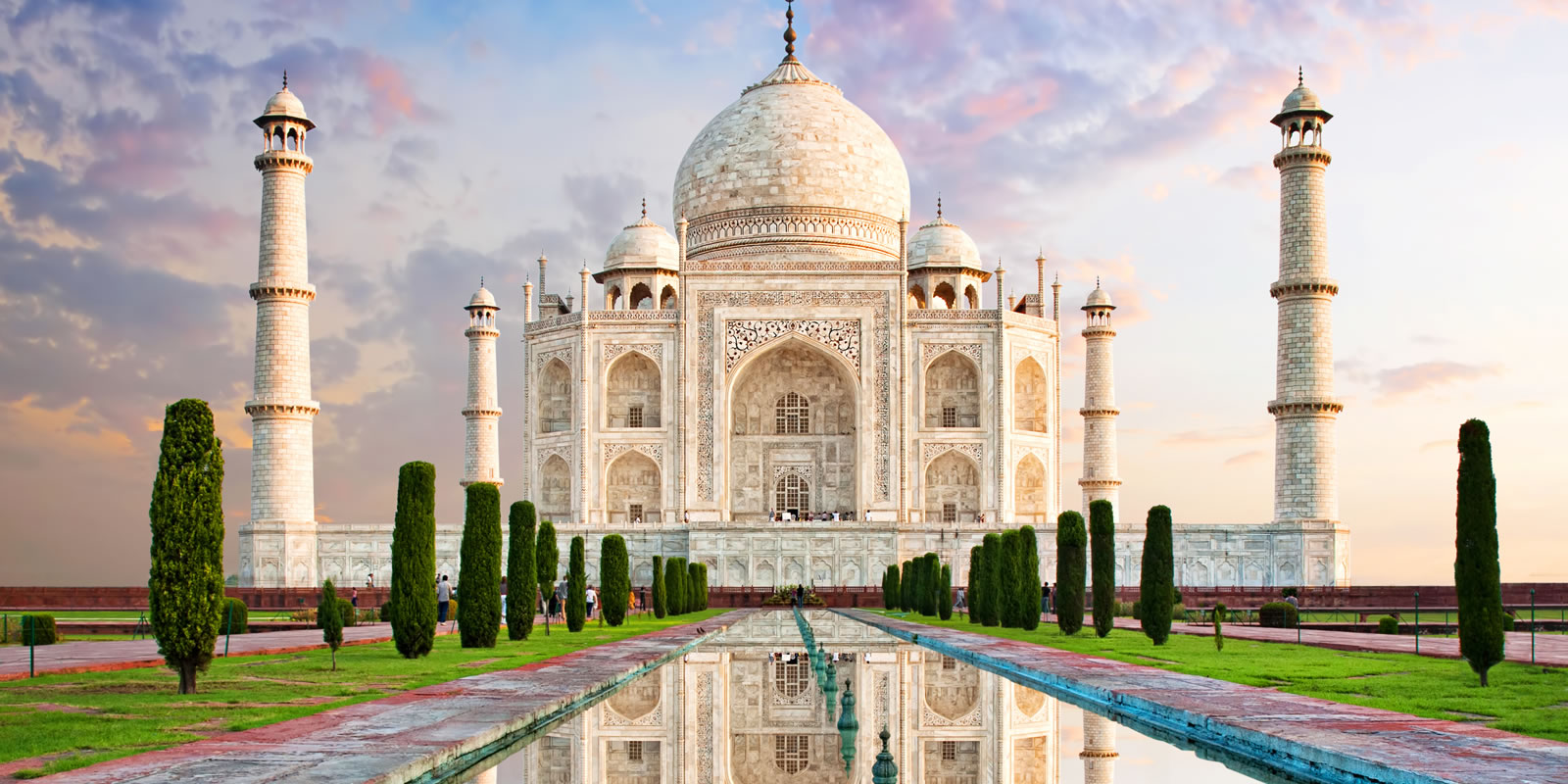
At the center of it all is a giant, onion-shaped dome that reaches high into the sky. It is surrounded by four smaller domes, creating a stunning silhouette. Four tall, slender towers, called minarets, stand at the corners of the platform. They are designed to lean slightly outwards, so that in case of an earthquake, they would fall away from the main tomb instead of on top of it. The entire complex was designed to represent the gardens of paradise as described in the Quran. A long water channel in the garden reflects the image of the Taj Mahal, making it look like it's floating between the sky and the earth.
Even the writing you see on the grand archways is a work of art. It's calligraphy, with verses from the Quran written in black marble. The artist cleverly made the letters at the top larger than the ones at the bottom, so that when you look up from the ground, they all appear to be the same size. Every single detail, from the biggest dome to the smallest carved flower, was planned and created with incredible care and skill. It’s a perfect blend of Persian, Islamic, and Indian architectural styles, coming together to create something the world had never seen before.
A Symbol of Faith and Culture
While the Taj Mahal is known worldwide as a symbol of love, it is also a deeply spiritual place. It was built following the principles of Islamic architecture, which aims to represent the beauty and order of the divine world. The entire complex is laid out like a garden of paradise, a concept central to Islam. The gardens, with their flowing water and fragrant flowers, were meant to give visitors a taste of what heaven might be like. The tomb itself is a house for the departed, a place for eternal rest.
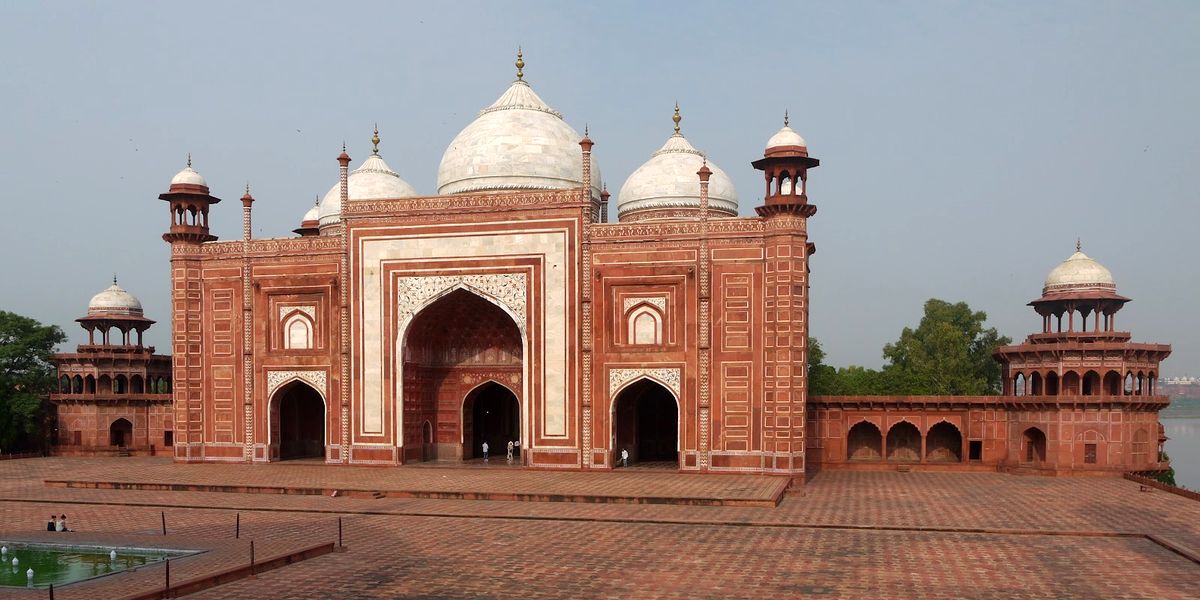
To the west of the main tomb stands a mosque made of red sandstone. It faces the holy city of Mecca and is still used for prayers, especially on Fridays. To maintain the perfect symmetry of the complex, an identical building, known as the 'jawab' or 'answer', was built on the eastern side. It wasn't used as a mosque because it doesn't face Mecca, but it was essential for architectural balance. These buildings show that the Taj Mahal was not just a monument to a person, but also a place of worship and reflection, connecting the earthly world with the spiritual one.
For the people of India and for Muslims around the world, the Taj Mahal is a source of immense pride. It represents the height of Mughal art and culture, a time when science, art, and architecture flourished. The intricate designs, the calligraphy from the Quran, and the overall peaceful atmosphere make it a sacred site. It reminds people of a rich history and a legacy of beauty that has been passed down through generations. It is a place where art, love, and faith all come together in perfect harmony.
Protecting a Treasure Through Time
The Taj Mahal has stood for centuries, but it hasn't always been easy. After Shah Jahan's reign, the Mughal Empire began to decline, and the monument was neglected for a time. During the 1800s, when the British were in India, some parts of the Taj were damaged, and some of its precious stones were reportedly stolen. It was a sad period for this magnificent structure. But then, in the early 20th century, a British viceroy named Lord Curzon started a major restoration project. He understood how important the Taj was and worked hard to bring it back to its former glory. The gardens were redesigned, and the marble was cleaned and repaired.
In more recent times, the biggest threat to the Taj Mahal has been pollution. The smoke from factories and cars in the city of Agra began to turn the beautiful white marble yellow. To protect it, the Indian government has taken many steps. A large area around the monument has been declared a no-traffic zone, so cars and buses have to stay far away. Many of the nearby factories have been closed or forced to use cleaner technology. The monument itself gets regular "mud pack" treatments, where a special clay is applied to the marble to draw out the pollutants, much like a face mask for a building. This helps to keep its white surface shining bright.
These preservation efforts are a huge international undertaking. Organizations like UNESCO, which named the Taj Mahal a World Heritage Site in 1983, work with the Indian government to make sure it is protected for future generations. It’s a constant challenge to balance the needs of the millions of tourists who visit each year with the delicate task of preserving such an old and precious structure. But it’s a job that everyone takes very seriously because the Taj Mahal doesn’t just belong to India; it belongs to the whole world.
A Legacy That Inspires the World
Why is the Taj Mahal so famous? It’s not just because it’s beautiful. It’s because it tells a story that everyone can understand: a story of love. The tale of Shah Jahan and Mumtaz Mahal has traveled across the world, making the monument a universal symbol of devotion. People from all countries, cultures, and religions are drawn to it, not just to admire its architecture, but to feel the powerful emotion that created it. It’s a place that proves that some things, like love and beauty, can last forever.
The Taj Mahal’s influence can be seen in art, poetry, and even other buildings around the world. It has inspired countless artists and writers. The famous Indian poet Rabindranath Tagore described it as "a teardrop on the cheek of time." In 2007, it was officially named one of the New Seven Wonders of the World, confirming its status as one of the most beloved and admired structures ever built by humankind. Millions of people visit every year, and each person leaves with a sense of wonder and awe.
Today, the Taj Mahal is the most recognizable symbol of India. It represents the country's rich cultural heritage and its history of artistic achievement. But its legacy is even bigger than that. It stands as a reminder that even in a world that is always changing, beauty can endure. It teaches us that out of great sadness can come something incredibly beautiful, and that the desire to honor a loved one can lead to the creation of something truly immortal. The Taj Mahal is not just a building; it's a feeling, a story, and a timeless inspiration for all of humanity.